Integrative Somatic Trauma Therapy (ISTT)
How trauma lives in the body
Trauma isn’t defined by what happened — it’s defined by how it affected you. It occurs when an experience overwhelms your capacity to respond, protect yourself, or escape.
Trauma can come from moments that were too much, too soon; or from years of too little, too late.
Once the body has gone through trauma, if this remains unprocessed and unexpressed, it usually stays on alert. It doesn’t know the danger has passed.
As a result, long after the experience is over, related sensations, situations, or relationships can trigger the same feelings of helplessness, and therefore, the same survival responses.
What is Integrative Somatic Trauma Therapy?
Because trauma lives in the nervous system, it can’t be repaired through intellectual understanding alone.
Instead, Integrative Somatic Trauma Therapy (ISTT) provides a path to help the body re-experience what was once overwhelming in small, manageable doses, within the safe and attuned container of therapy.
This approach, known as titration, helps your brain re-categorize what is being incorrectly perceived as universally dangerous because of its association to a traumatic experience (for example, a tone of voice) - as safe.
Over time, this means that reactivity to the trigger lessens, and eventually it stops eliciting a survival response at all.
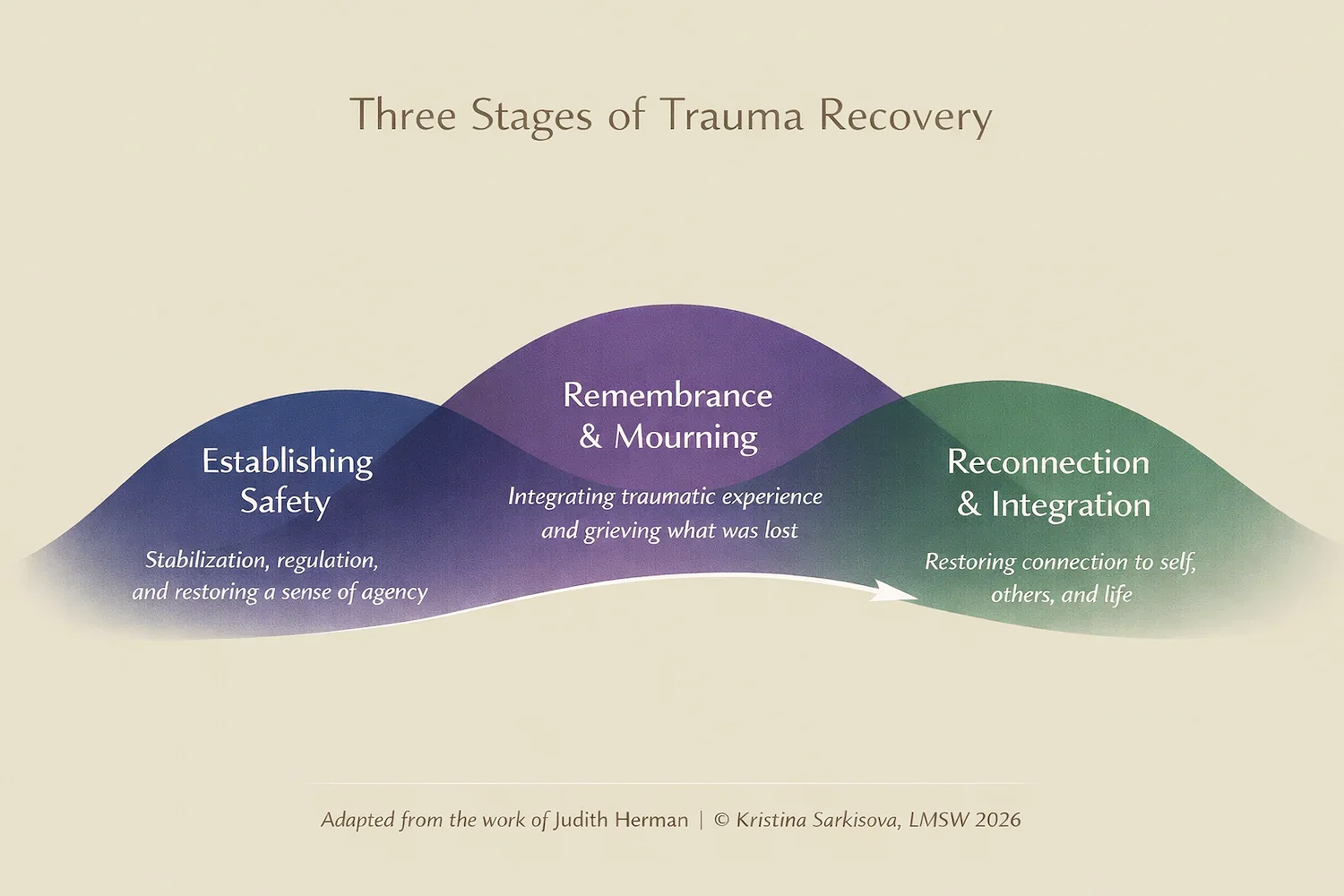
Before processing, however, ISTT focuses on regulation and resourcing. We work at a pace that respects your capacity, following your body's wisdom rather than pushing through pain.
ISTT integrates techniques from frameworks including Sensorimotor Psychotherapy, Hakomi, Polyvagal Theory, Somatic Experiencing, Interpersonal Neurobiology, and Internal Family Systems, creating a comprehensive path to healing that honors both your protective responses and your capacity for change.
“Our injuries do not occur in a vacuum,
so our healing cannot occur in one either.”
- Dr. Arielle Schwartz
Who is ISTT for?
ISTT may be a good fit if:
You startle easily, scan rooms when you enter, or feel safest near exits
Your body reacts - clenched jaw, tight chest, breath held - before your mind has a chance to catch up
You move through the world like a raw nerve, always braced for the next thing
Sleep feels fraught—either you can't fall asleep, can't stay asleep, or wake up exhausted
An unexpected trigger can leave you in a state for days, and you can't always explain why
Small things feel like too much—noise, decisions, conversations that used to be easy
You don't recognize yourself in your own reactions, like your body hijacked the person you thought you were
Intimacy feels threatening even when you want it
Trust feels dangerous, even with people who've proven themselves safe
You go numb and disappear, or feel cornered and explode, when things get too close or too real
Conflict, even if of the healthy variety, feels like the end of the world
You’ve benefitted from talk therapy before, but your most challenging symptoms remain
What are sessions like?
In ISTT, we don’t linger on the “why”. Instead, we work with the “what” and the “how”, tracking what's happening in your body in real time rather than circling it analytically.
Sometimes, telling the story feels meaningful. Other times, it's retraumatizing. You're never required to recount what happened, and you’re always the one in control.
During sessions, we might:
Reconnect with how safety, rest, and pleasure feel in your body - not just the absence of danger
Notice where you feel sensations like tightness, heat, numbness, buzzing - and stay with them with curiosity and non-judgment
Map your body’s unique warning signs so you recognize when you’re headed towards dysregulation
Practice moving between activation and calm (this is called pendulation), so your body learns it can always get unstuck
Use gentle movement techniques that help your body finish responses it couldn't complete at the time of the trauma
Process at the pace your body can handle, not a pace set by a protocol
If something feels like too much, we pause, slow down, or change course.
Trauma happens in isolation and powerlessness.
Healing happens in safety and connection.
You were never meant to do this alone.
Ready to do this - or want to talk and learn more?
Get in touch
You’re welcome to schedule a free 30-minute consultation with me directly, or you can use the contact form if starting in writing feels easier.