Services
Therapy is a meaningful investment
of time, energy, and resources.
The information below outlines service and fee options to provide transparency as you consider what is right for you.
-
Ongoing 50 min. weekly therapy sessions.
Depending on your needs, every-other-week sessions may also be an option. -
Longer 90 min. sessions, for those who may benefit from a slower pace or having more processing time.
Limited availability. -
A comprehensive package for new clients who want more support and greater immersion in the work from the outset.
Who it’s for: Clients who feel anxious about starting therapy, have had difficult therapy experiences in the past, want to “hit the ground running”, or want a more intentional introduction to somatic work.This format is much more structured than standard sessions (see below), and is not suited to trauma processing.
How it works: we take a full day to slow down, build a sense of rapport and safety, orient to your needs and nervous system, and collaboratively map out treatment.
This package is offered once per month on a Sunday and includes:30 minute screening call prior to the day
One structured Sunday with three paced sessions:
90 minutes
60 minutes
30 minutes
Planned breaks to support regulation and integration
This package is designed as a supported entry into ongoing weekly therapy and is not a standalone service.
Fees & Practical Details
I offer 30 minute consultations free of charge so we can explore our fit before scheduling a paid session.
50 minute sessions: $145
90 minute sessions: $245
Intro to Therapy Intensives: $650
Sliding Scale
I reserve a limited number of sliding scale spots for clients who might not otherwise be able to access therapy.
CURRENTLY FULL
For more info, please see FAQs below.
Superbills
If you have out-of-network behavioral health benefits, I’m happy to provide superbills for you to submit to your insurance for possible reimbursement.
Services like Thrizer, Reimbursify and Mentaya (no affiliation) can also do this for you for a small fee per claim.
Insurance is not accepted
Pricing questions, answered
-
A sliding scale is a pricing approach where fees can be adjusted based on a person’s ability to pay.
The goal is to reduce financial barriers and make care more accessible.
My reduced fee range is between $75 - $100/ 50 min session.
I don’t offer 90 min sessions at sliding scale.
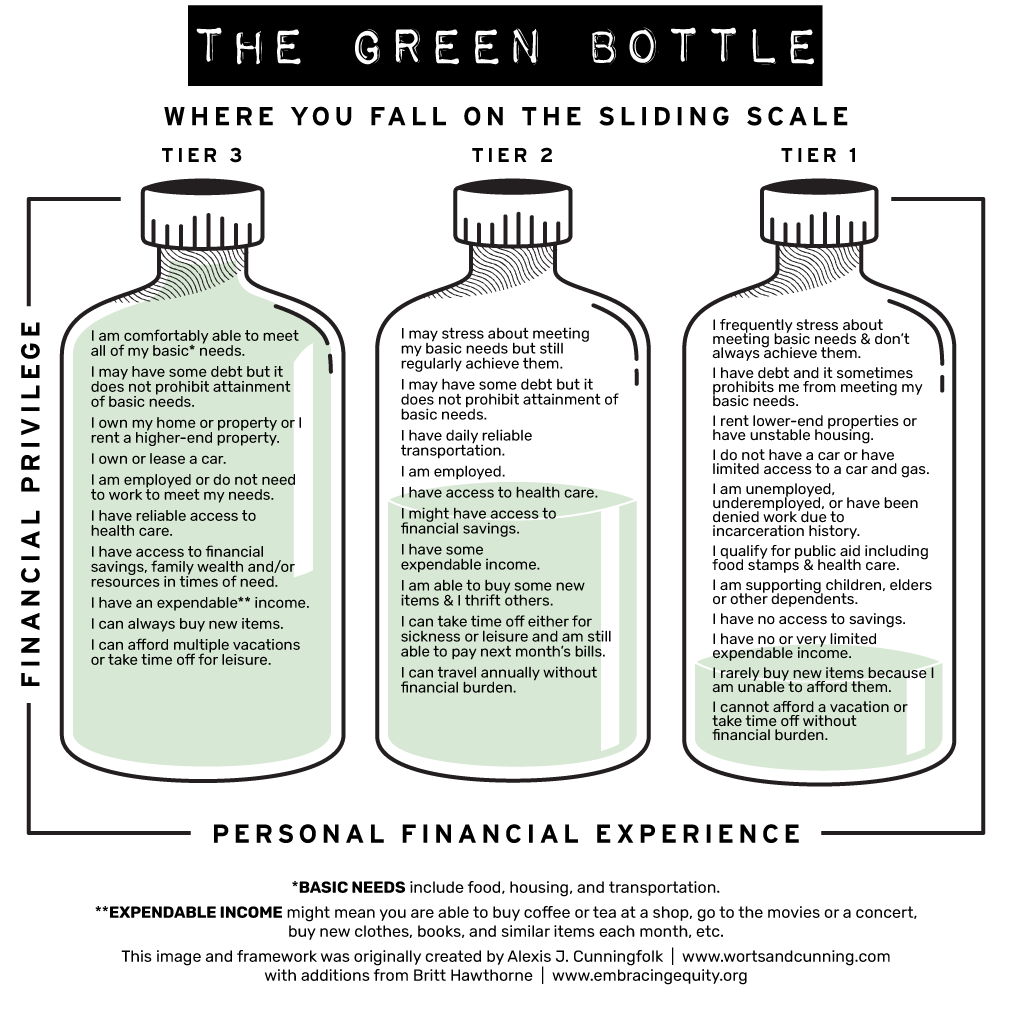
The Green Bottle model is a helpful resource if you want to explore where you might fall on the scale.
How sliding scale works in my practice:
I reserve five sliding-scale spots in my caseload at all times. Offering a limited number of spots allows me to do this sustainably.
These spots are currently full
You’re welcome to request to be added to the waitlist for the next opening.
If you request sliding scale:
You’ll complete a brief form to help determine a fee range.
We’ll review it together and decide on a rate collaboratively.
-
Insurance-based care often comes with extensive administrative burdens (for clients and therapists), limits on the number or type of sessions that can be provided, requiring a diagnosis on your chart, and the sharing of personal health information.
Practicing independently allows for greater privacy, flexibility, and the ability to work at a depth that isn’t constrained by those requirements.
-
TL;DR: Therapy fees cover much more than the session itself, including prep, documentation, follow-up, and the costs of running a practice. Most private practice therapists aren’t salaried or benefit-supported, so the take-home amount is significantly smaller than what an hourly fee may suggest.
What therapy fees include. Therapy fees reflect more than the time we spend together. They also include preparation prior to the session, documentation after, administrative work, providing referrals and resources when these are needed, and the additional clinical or research time that individual cases may require.
How private practice works. In private practice, therapists aren’t usually salaried, and many don’t have benefits. Income depends on the sessions that take place, which is why cancellation policies matter: when a session is canceled late, that time can’t be offered to someone else, or has already been spent - which results in lost income. Additionally, in group practices, therapists typically only take home a percentage of their listed fee.
Ongoing professional requirements. Ethical psychotherapy practice requires ongoing supervision, sometimes consultation, and continuing education and training, most of which is usually paid out of pocket. There are also additional costs involved in maintaining a practice (even a virtual one!) including malpractice insurance, licensing fees, marketing, client resources, and HIPAA-compliant software.
-
That’s great - I’m excited to meet you!
Please email me at kristina@centralaustinpsychotherapy.com or fill in the contact form below to request an appointment or free 30 minute initial consultation, or book a consultation directly through my calendar. I’ll be in touch shortly.
We’ll then meet to discuss your needs and whether we’re a good fit. If you’d like to proceed, we’ll choose a regular session time, and I’ll send you some brief paperwork through SimplePractice - a secure, HIPAA-compliant platform we’ll also use for our sessions.
Get in touch
You’re welcome to schedule a free 30-minute consultation with me directly, or you can use the contact form if starting in writing feels easier.
When scheduling, you’ll be asked for a credit card as part of the standard booking process. There is no charge for the consultation, and this will only be used should we decide to work together.
BLOCK